
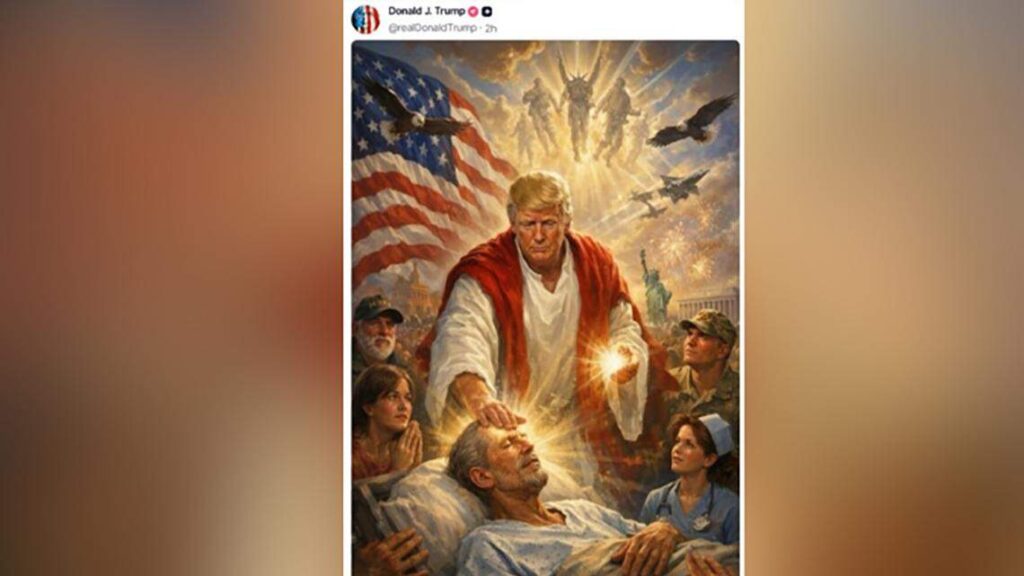
The other day, President Donald Trump posted and then deleted an AI-generated image from Truth Social that depicted him as a Jesus-like figure healing a man. Trump claimed he thought the image portrayed him as a “doctor” or “Red Cross worker” rather than Jesus. Any reasonable person would take a look at that picture and say his explanation is difficult to take seriously.
I know the president will never see this little blog, but I do want to give him a message: President Trump, we do not need another Lord and Savior, that was taken care of completely by Jesus Christ. And for you to even jokingly put yourself in a similar category is not only blasphemous but is exposing a deadly and dangerous trait that is likely hiding in your soul: pride.
 “Pride goes before destruction, and a haughty spirit before a fall” (Proverbs 16:18). This verse is not referring to a country of political party, but to individuals. If you do not humble yourself and give your life to God, then your haughty spirit is headed for a fall. As James writes, “God opposes the proud but gives grace to the humble.”
And that is true for everyone, leader or citizen. Pride sees yourself as greater than God, equal with God, or that God is unnecessary. True faith recognizes that your salvation is only through the mercy and grace of Jesus Christ and focuses on glorifying God with your life.
Pride is not something that is exclusive to the Oval Office. It was front and center throughout scripture as well. And through these lives we see the dangers of living with pride.
Nebuchadnezzar stood on the roof of his palace and looked out over Babylon and said, “Is not this great Babylon, which I have built… by my mighty power?” He took full credit for what only God could have given. The kingdom, the power, the glory. All of it was handed to him by God, but in his pride he rewrote the story and made himself the hero. And the moment he did, God humbled him, stripping him of his sanity until he finally looked up and acknowledged heaven.
Pride says, “I built this,” but faith says, “God gave this.”
King Uzziah started so well. He sought the Lord, he was strengthened, he prospered, but then success quietly turned into pride. Instead of staying within the role God gave him, he stepped into the temple to burn incense, a responsibility reserved for the priests. He crossed a line, not because he forgot the law, but because he thought he was above it. And God struck him with leprosy, removing him from leadership.
Pride says, “I can do whatever I want,” but faith says, “I will stay within what God has called me to do.”
Pharaoh looked Moses in the face and said, “Who is the Lord, that I should obey his voice?” That’s not just ignorance, that’s defiance. He positioned himself as the highest authority, refusing to submit even as plague after plague devastated his land. Each warning was an opportunity to humble himself, but pride kept hardening his heart until it led to his destruction in the Red Sea.
Pride says, “I will not bow,” but faith says, “I will obey the Lord.”
Herod Agrippa stood before the people, and when they shouted, “The voice of a god, and not of a man,” he didn’t correct them. He accepted it. He absorbed the praise that belonged to God alone, and in that moment revealed what was in his heart. He didn’t need to claim to be God, he just needed to enjoy being treated like one. And immediately, God struck him down.
Pride says, “I deserve the glory,” but faith says, “All glory belongs to God.”
Saul’s downfall wasn’t loud arrogance at first, it was subtle. He offered sacrifices he wasn’t supposed to offer. He disobeyed God’s clear commands and then justified it by saying he feared the people. But underneath it all was a desire to control the situation and protect his image. He wanted the benefits of obedience without actually submitting to God. And because of that, the kingdom was taken from him.
Pride says, “I need to manage how this looks,” but faith says, “I will obey God no matter the cost.”
Absalom slowly built a following behind his father’s back, positioning himself as the better leader, the one who could fix what was broken. He won people over with charm, appearance, and promises, but it was all rooted in self-exaltation. He wasn’t content to wait on God’s timing or honor the authority God had established, he wanted the throne now. And his rebellion ended in death and devastation.
Pride says, “I deserve that position,” but faith says, “I will trust God’s timing and place.”
The king of Tyre, in Ezekiel’s prophecy, takes pride to its most extreme form. He says, “I am a god… I sit in the seat of the gods.” This is blatantly placing himself in God’s seat. He trusted in his wisdom, his wealth, his success, and concluded that he was more than a man. But God declared that he would be brought low and exposed for what he truly was.
Pride says, “I am god,” but faith says, “There is only one God, and it is not me.”
At the Tower of Babel, humanity came together with one unified goal: “Let us make a name for ourselves.” They weren’t building in obedience to God, but in defiance of Him. It was collective pride, a culture united around self-glory instead of God’s glory. And so God confused their language and scattered them, breaking apart what they had built.
Pride says, “Let us make a name for ourselves,” but faith says, “Let us make much of God’s name.”
Judas walked with Jesus, heard His teaching, saw His miracles, and yet somewhere along the way, his heart turned. He didn’t just stumble into betrayal, he purposely moved toward it. He valued money more than Christ, control more than surrender, and ultimately handed Jesus over for thirty pieces of silver. Even in the garden, he approached Jesus with a kiss, which is a sign of affection masking a heart of rebellion. Judas wanted the benefits of following Jesus, but not the cost of truly submitting to Him.
Pride says, “I will use Jesus for what I want,” but faith says, “I will give my life to Jesus for what He wants.”
Pontius Pilate stood face to face with Jesus and knew something wasn’t right. He declared, “I find no guilt in him,” and yet he still handed Him over to be crucified. Why? Because he feared the crowd. He feared losing his position. He feared what it would cost him to stand for truth. So he tried to wash his hands of it, pretending neutrality, but there is no neutrality when it comes to Jesus. Pilate had the authority to do what was right, but he chose what was safe instead.
Pride says, “I will protect my position,” but faith says, “I will stand for truth no matter the cost.”
The religious leaders looked at Jesus hanging on the cross and mocked Him, saying, “He saved others; he cannot save himself.” They thought the cross proved He wasn’t the Savior, when in reality it was the very proof that He was. Their pride blinded them. They were so convinced of their own righteousness, their own understanding, their own system, that they rejected the Son of God standing right in front of them. They didn’t just miss Jesus, they actively opposed Him, all while thinking they were right with God.
Pride says, “I know better than God,” but faith says, “I will humble myself and trust His way, even when I don’t understand.”
Hopefully from these examples you see the danger of pride. Let’s learn from scripture and be determined to live out a life of humble faith instead. This world does not need leaders with a prideful Jesus-like complex. What this world truly needs are those who humble themselves before God, are praying and seeking his face, and turning from their wicked ways. Only then will God hear them, forgive them, and heal their land (2 Chronicles 7:14).